
Wednesday, November 07, 2007
Aboriginal Health Summit
 I’ve not been feeling very well for about 6 weeks now. First I had the flu, and sinus infection. Getting over that, I developed pain in my right shoulder. This impingement got so bad that I’ve had to stop all swimming with my arms. I am reduced to kicking with the float boards which is very frustrating. And to top it off, in Port Hedland I got bitten by sandflies, and about 4 days later developed a serious case of papular urticaria. The itching has been so bad that I sleep only by taking 50 mg of Benadryl and taking an ice pack to bed with me. The antihistamine makes me hung over until about noon each day. So I am not my usual perky self. The good news is that my students passed their OSCE’s. This week we are having final tutorials before they leave Derby next week for final exams in Perth.
Last week was the Aboriginal Health Summit in Broome. I stopped and attended for a couple of days on the way back from Port Hedland.
Two talks caught my attention.
First, a talk by an architect, Paul Pholeros talked about housing and health in Aboriginal communities. The prevailing Australian prejudice is that “Aboriginal people are given free houses that they don’t take care of, and in fact actively destroy”. Even my hairdresser here in Derby repeated this attitude to me this week. The truth, based on surveys of 5232 Aboriginal homes, is that only 10 percent of 91,819 items in these homes were damaged by overuse, misuse, abuse or vandalism. A much bigger problem is that 70% of repairs were needed for shoddy or incorrect initial construction. The remainder of problems were due to the harsh Outback environment. Outside of urban areas, most water in Australia is very high in mineral salts, which results in rapid corrosion of tap seats, for example.
 In one community, 40 of 76 hot water units fitted in a government program were leaking due to a manufacturing fault, yet warranty claims were not honored. In essence, government housing programs put in very expensive housing- up to $AUD 400,000 per Outback home- which goes to the lowest bidder and results in a sub par construction that does not last. As a result, in many Aboriginal communities, only 33 % of homes had a working shower, only 55% a functional toilet, over 90% had unsafe electrical systems, and over 95% did not have a functional kitchen where food could be stored, prepared and cooked. Is it any wonder that poor nutrition, skin diseases, and diarrhea and respiratory diseases run rampant?
Mr. Pholeros is part of a project in South Australia called HealthHabitat. They go into a community and teach the local people to survey, then repair the problems. His plea was that it is much cheaper to build homes correctly the first time, and provide local people with skills, tools and supplies to maintain the homes. Their program focuses on improving housing to promote the Nine Healthy Living Habits. Just fixing the water systems in one community saved $AUD 67,000 in water bills and over 100 million liters of water in this arid country.
Unfortunately, in 2006 the Minister for Indigenous Affairs could not account for how more than $AUD 2 BILLION had been spent on housing in the previous decade.
Perhaps a new government will spend the money more wisely? Mr. Pholeros has been researching and writing about these issues since 1993. He is the soul of persistence.
_________________________________________________________________
The second story was about an Aboriginal community, Baryulgil, in New South Wales. These people were able to keep their land and preserve their culture. They were even lucky enough to find jobs on their land, mining a valuable natural resource. Unfortunately, this resource was asbestos. A similar story unfolded in Western Australia around Wittenoon and Roeburn. The presentation was focused on efforts to gain the communities’ trust. In one community, the son of the chairman went to University and studied anthropology and oral history collection. He has been hired to interview the old peoples’ stories about the mines, in order to collect data for compensation. This is needed, because the company that ran the mines, James Hardie, suffered “mysterious fires” that burned only the file cabinets containing the personnel health records of the miners. Also, the original chest x-rays of all these workers were sent off for review by the company, and also “disappeared” from the face of the Earth. While a settlement was negotiated two years ago, the company has not paid a cent yet to victims. When I shared this story with my mentor, Dr. David Atkinson, he said, “The irony around Aboriginal health never ends.” Barristers plan to bring new test cases to the courts.
____________________________________________________________
Finally, the newly released draft drinking guidelines for Australia are getting a bit of press here. Most of the controversy is not about the science or safety of the guidelines, but whether they are "realistic".
Labels: Aboriginal Health


Saturday, October 06, 2007
Windjana Gorge and Tunnel Creek
It's the Queen's Official Birthday, October 1st here in Western Australia. Actually, it's not really her birthday which is April 21st. And it's not her Birthday anywhere else in Australia except Western Australia. The rest of the country celebrates on the 2nd Sunday in June which is the beginning of snow season. The Governor of WA sets the holiday for this state, which just coincidentally happens to be the Monday after the biggest sports weekend of the year- the Grand Finals for the Australian [Rules] Football League, and the Australian Rugby league- held on Saturday and Sunday, respectively.
CLICK PHOTOS TO SEE ALBUMS
Because we are not into celebrating a history of colonization, or watching the impacts of sweaty men on the playing fields, we decided it would be more appropriate to visit Windjana Gorge and Tunnel Creek.
We had planned to visit Windjana Gorge for a long time but had put it off for various reasons. I'd read that this was a sacred spot, but actually walking in this place brought home its magical nature. This is an area with deep spiritual historical significance to the local Aboriginal people.
 Windjana Gorge is a chasm where the Lennard River cuts through the Napier range. For centuries it was a holy place to the Bunuba people. They believe that the spirits of their unborn children rested in the permanent waterhole beneath a giant boulder. And the people did not live in the Gorge despite its abundant wildlife. For them it was a place of life and power; it was the place they laid their dead, wrapped in bark, in the cliffs.
So in the 1860's, when cattlemen invaded the country, enslaving the men, raping the women, and moving cattle into these sacred places it sparked resistance. Jandamarra, a Bunuba man, turned on the police who were enslaving his people, and waged a guerrilla war for over 3 years. He led a battle to protect the Gorge and hid out in Tunnel Creek. Vicki and I read his story in Jandamarra and the Bunuba Resistance and we are here to visit these battlefields on the Queen's Birthday holiday.
We left the house at 0630, and bumped up the Gibb River Road to the turnoff to Windjana. It is a very hot day, forecast to hit 40C. By 9 AM we are on the track up the gorge, with camera and water bottle. We walk through a narrow crack in the rock-the gateway to a magical world. A cloud of butterflies rises out of crevices in the rock walls and flutters about our head. The trail is listed as 7 km round trip. Vicki took off at her usual blistering pace and within 45 minutes was out of sight. I lagged behind, stopping to photograph the wonderful birds and wildlife. The gorge is magnificent, with red rocks radiating both heat and power. The cries of the cockatoos and other birds echo within the canyon. The still green water reflects the cloudless sky and freshwater crocodiles swim lazily. But it is hot. After a couple of kilometers the trail rises and runs close to the cliff base. I see there is quite a distance to the end of the gorge still. I come upon Vicki who is sitting on a rock, not looking so well. She is overheated and starting to get a bit nauseated. I make her drink most of the water and sprinkle some on her hair. By this point the Gorge is like an oven, with the sun higher, and reflecting off the rock walls, the water and the sand. Out of the shade the sun feels 20 degrees hotter. I am reminded of the old movies, where parched men slog across the desert seeing mirages, as we run out of our water and are still a kilometer away from the car. We keep to the shade and take it slowly. The last 100 meters across the parking lot are torture, but we open the car, turn the aircon on high, and guzzle more water from the esky. It feels great, but we are parched and just sit there for 20 minutes, nibbling on our peanut butter sandwiches for the salt. Even prepared, it is so easy to get heat exhaustion in this country, I can understand how many people die just meters away from their vehicles.
 We drive down to the Lillimilura Police Station. This is where Jandamarra's conscience finally led him to start resisting. The only marker here is to the policeman he shot. And while it's true he shot him in his sleep, he did it only after severe and prolonged provocation. Later in his guerrilla war, he and his men tried to drive the settlers and police away with psychological warfare- raining rocks down from the heights on top of the police station at night, stealing the cops' food and weapons- when they could have very easily massacred every policeman in retaliation for enslaving their families. It is ironic that the only monument in these national parks is to the white man. One of my medical students told me this made him so angry, that when he visited he pissed on this marker. From the stains it is clear he was not the only one. I like to think I am too civilized- but the truth is I'm just too dehydrated- to join in. But I mentally applaud those who do.
CLICK PHOTOS TO SEE ALBUMS
Twenty-nine kilometers down the road, through dry, scrubby, rocky hills and boabs, we come to Tunnel Creek. We put on our wading shoes, and again enter a sacred place through a narrow cleft in the mountain. It is amazing: dry, cool, very wet- a cave full of life. There are small fish in the water, and a colony of large flying fox bats hanging from the ceiling and from a tree outside. Water drips from the flowstone and stalactites overhead. We walk on through, using our little crank flashlights. Just as it gets so dark we can't see anything but the narrow beams, a glimmer of light appears ahead, and we come to the middle, where the tunnel has opened to the sky. The dark to light transition happens again after walking past this area to the far end- but here the water from the cave flows out into a lovely creek with water bugs, little fish and kookaburras in the gums overhead. It is remarkably cooling- the yin to the yang of the Gorge.
We complete the loop by driving through the Bunaba people's current lands. These resemble nothing more than a post-nuclear attack landscape, with burned over rocky soil punctuated by blackened, twisted trees. It is awful country. A sign to one of the communities has a cow skull hanging on it. It is a relief to regain the Great Northern Highway and drive the two hours back to Derby.
I am struck by the lack of Aboriginal involvement in these Australian National Parks. Imagine the Little Big Horn monument without Native American input and presence. It is a sad legacy. Here in Australia, Ned Kelly, a lowlife criminal, is admired, while Jandamarra is still seen as a terrorist, instead of the freedom fighter he truly was.
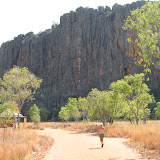 |
| Windjana Gorge |
Because we are not into celebrating a history of colonization, or watching the impacts of sweaty men on the playing fields, we decided it would be more appropriate to visit Windjana Gorge and Tunnel Creek.
We had planned to visit Windjana Gorge for a long time but had put it off for various reasons. I'd read that this was a sacred spot, but actually walking in this place brought home its magical nature. This is an area with deep spiritual historical significance to the local Aboriginal people.
 Windjana Gorge is a chasm where the Lennard River cuts through the Napier range. For centuries it was a holy place to the Bunuba people. They believe that the spirits of their unborn children rested in the permanent waterhole beneath a giant boulder. And the people did not live in the Gorge despite its abundant wildlife. For them it was a place of life and power; it was the place they laid their dead, wrapped in bark, in the cliffs.
So in the 1860's, when cattlemen invaded the country, enslaving the men, raping the women, and moving cattle into these sacred places it sparked resistance. Jandamarra, a Bunuba man, turned on the police who were enslaving his people, and waged a guerrilla war for over 3 years. He led a battle to protect the Gorge and hid out in Tunnel Creek. Vicki and I read his story in Jandamarra and the Bunuba Resistance and we are here to visit these battlefields on the Queen's Birthday holiday.
We left the house at 0630, and bumped up the Gibb River Road to the turnoff to Windjana. It is a very hot day, forecast to hit 40C. By 9 AM we are on the track up the gorge, with camera and water bottle. We walk through a narrow crack in the rock-the gateway to a magical world. A cloud of butterflies rises out of crevices in the rock walls and flutters about our head. The trail is listed as 7 km round trip. Vicki took off at her usual blistering pace and within 45 minutes was out of sight. I lagged behind, stopping to photograph the wonderful birds and wildlife. The gorge is magnificent, with red rocks radiating both heat and power. The cries of the cockatoos and other birds echo within the canyon. The still green water reflects the cloudless sky and freshwater crocodiles swim lazily. But it is hot. After a couple of kilometers the trail rises and runs close to the cliff base. I see there is quite a distance to the end of the gorge still. I come upon Vicki who is sitting on a rock, not looking so well. She is overheated and starting to get a bit nauseated. I make her drink most of the water and sprinkle some on her hair. By this point the Gorge is like an oven, with the sun higher, and reflecting off the rock walls, the water and the sand. Out of the shade the sun feels 20 degrees hotter. I am reminded of the old movies, where parched men slog across the desert seeing mirages, as we run out of our water and are still a kilometer away from the car. We keep to the shade and take it slowly. The last 100 meters across the parking lot are torture, but we open the car, turn the aircon on high, and guzzle more water from the esky. It feels great, but we are parched and just sit there for 20 minutes, nibbling on our peanut butter sandwiches for the salt. Even prepared, it is so easy to get heat exhaustion in this country, I can understand how many people die just meters away from their vehicles.
 We drive down to the Lillimilura Police Station. This is where Jandamarra's conscience finally led him to start resisting. The only marker here is to the policeman he shot. And while it's true he shot him in his sleep, he did it only after severe and prolonged provocation. Later in his guerrilla war, he and his men tried to drive the settlers and police away with psychological warfare- raining rocks down from the heights on top of the police station at night, stealing the cops' food and weapons- when they could have very easily massacred every policeman in retaliation for enslaving their families. It is ironic that the only monument in these national parks is to the white man. One of my medical students told me this made him so angry, that when he visited he pissed on this marker. From the stains it is clear he was not the only one. I like to think I am too civilized- but the truth is I'm just too dehydrated- to join in. But I mentally applaud those who do.
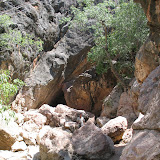 |
| Tunnel Creek |
Twenty-nine kilometers down the road, through dry, scrubby, rocky hills and boabs, we come to Tunnel Creek. We put on our wading shoes, and again enter a sacred place through a narrow cleft in the mountain. It is amazing: dry, cool, very wet- a cave full of life. There are small fish in the water, and a colony of large flying fox bats hanging from the ceiling and from a tree outside. Water drips from the flowstone and stalactites overhead. We walk on through, using our little crank flashlights. Just as it gets so dark we can't see anything but the narrow beams, a glimmer of light appears ahead, and we come to the middle, where the tunnel has opened to the sky. The dark to light transition happens again after walking past this area to the far end- but here the water from the cave flows out into a lovely creek with water bugs, little fish and kookaburras in the gums overhead. It is remarkably cooling- the yin to the yang of the Gorge.
We complete the loop by driving through the Bunaba people's current lands. These resemble nothing more than a post-nuclear attack landscape, with burned over rocky soil punctuated by blackened, twisted trees. It is awful country. A sign to one of the communities has a cow skull hanging on it. It is a relief to regain the Great Northern Highway and drive the two hours back to Derby.
I am struck by the lack of Aboriginal involvement in these Australian National Parks. Imagine the Little Big Horn monument without Native American input and presence. It is a sad legacy. Here in Australia, Ned Kelly, a lowlife criminal, is admired, while Jandamarra is still seen as a terrorist, instead of the freedom fighter he truly was.
Labels: Aboriginal Health
Wednesday, September 26, 2007
Many Dimensions

Vicki picks me up from the Derby Aerodrome, hot and sticky after an hour and a half in the plane returning from the remote community flight. All I can think of is getting into the shower as quickly as possible. I detest feeling dirty and germy. I can’t help it. I dump my backpack on the back porch, and strip off my clothes in the 38 C. heat so I won’t carry vermin into the house.
I’ve worked with poor people all my professional life, and I hope I have a small inkling of the psychology and environment of poverty. But most of the time, I have seen “the poor” in EDs, my own office, or the hospital or residency setting. I’ve made more than a few house calls over the years, so I’m not shocked anymore. But visiting an entire community is different. There is no place to rest your eyes; nowhere I am not confronted with the stark reality of my patients’ lives.
We fly in to the dusty airstrip in a GA8 Airvan, a very light, high-wing, single engine Australian-built plane. One of the old men in the community drives the 5 k to the strip in a battered ute to fetch us. The truck has a homemade wire bench on the bed, which is loosely attached. We pitch our many bags and boxes in the back. We have to bring everything from meds to band-aids to our own scales. The four of us: pilot, RFDS nurse, health worker, and I then clamber up and sit hip to hip for the bumpy ride to the community center.
The “center” itself is just a big dirty room with a beat up table. There is a kitchen counter which has hot and cold water. There is a dirt encrusted shower room, and around the back, the loo which has no toilet seat and rivals the worst service station johns. Four months ago when I was here the cockroaches were so bad, they were crawling into my doctor bag and all over the files within seconds of my setting the items on the small desk. DAHS threatened to cancel clinics unless the place was cleaned up. The community did a spit and swipe and bug-bombed the place, which helped for awhile, but now the insects are returning. The cockroaches always win in the end.
 We set up our gear and I dive in to see patients. I review the older peoples’ chronic disease files. We drew bloods 2 weeks ago, and some are doing well, some need their meds adjusted. The RFDS nurse spends a lot of the morning filling dosette boxes, those clever little plastic devices that set up a weeks worth of meds. Many of the patients speak poor English, so these are essential. I see a child with ringworm of the scalp and head lice. The mom is trying hard, but only had topical antifungal cream, which won’t kill the fungus at the roots. I only have adult strength Griseofulvin, but we work out that she can whack the tablets in half with a knife and a hammer. A gent I saw two weeks before shows me that his extensive pyoderma- boils that reminded me of Job’s sores- has improved, although is still not completely gone. A teenage boy got in a fight 4 days before, knocking out the lower teeth of his opponent, and now he has pus coming out of the human bite he sustained on his middle finger. It’s not bad enough to require the hospital yet, and I hope some high dose Augmentin and wound care might do the job. The last man is young, in his 30s, and has just moved to the community. He seems lost and wants something to help him sleep. I pull him into the back of the center’s not-so-private office, and he admits he is thinking of walking out into the bush and hanging himself. We talk about that, I express concern as best I can across the cultural gulf, start him on some antidepressants and make a referral to community mental health. God knows when they will get a worker out to him. I only know one community mental health worker, and blonde, white Sara is not someone this bloke will be able to easily talk with. He promises to come to the next clinic in a month at least. I hope confessing his black thoughts will help. I’m uneasy, but I’ve done the best I can.
I work right along. “Who’s next” I keep asking the nurses. Part of it is a desire to be efficient, but another part is just revulsion at the working environment and a wish to get the hell out as soon as possible. Prepared this visit, I’ve brought my own towel and dry handwash. I wash my hands as often as I can, but I have to touch the equipment as well as the patients. Everything is a fomite here.
At one point in the morning I step on the back porch and see 3 brilliant blue kookaburras on a branch in the back. But when I turn around, there are piles of trash, scattered cans, garbage bags, rusted machinery, paper, wire, horse manure and dog poo everywhere. It looks like some of the yards I used to see in my grandparents Appalachian community when I was a kid. I remember my parents encouraging me to actually see the poverty, if for no other reason, to appreciate what I had.

But this is poverty in more than one dimension. Financial poverty is the least part of it- as the people get CDEP and pension payments. There is emotional poverty and pain, related to the stealing of family relationships and structure. There is educational poverty: the older generation grew up on stations and never knew school; and now their children and grandchildren are truant and no one cares. With no training, there is vocational poverty, so that the annual cattle muster is the only work event providing any self-esteem, for 1 week a year. There is a spiritual poverty here, where life is out of whack, and the traditional owners of the land are no longer its protectors or custodians. And the end result is a poverty of hope. The people here live in the moment because the past is full of pain, the present is uncontrollable, and the future, unimaginable.
I realize the people in this particular community are mentally not "running on all cylinders". (Thank God not every community here is like this.) Combined effects of deprivation, isolation, racism, cultural loss, diseases, and too much grog leading to loss of neurons have done their damage. It’s not something I can fix on a fly-in. All I can do is really try to be with them in the moments when I visit. And I feel guilty, because a shower sure feels good afterwards.
Labels: Aboriginal Health
Sunday, March 18, 2007
Jarlmadangah

The wind blew the rain horizontally through the slats of the outdoor shower stall. I dropped the soap dish cover and it was gone in a flash, caught in the air jetting past my feet. The flimsy stall walls shook, and the thunder boomed from 360 degrees, echoing back and forth between the high canyon walls of Jarlmadangah community. Lightning broke the pitch blackness with actinic flashes showing branches, leaves and muddy dirt flying across the canyon floor. The rumbles from above shook the earth. I stepped out of the shower and was immediately wetter.
This happened on our 2nd night in Jarlmadangah. My three medical students and our Registrar, Marina, joined with 8 students from Broome and their faculty for a 2 day Aboriginal Health workshop in this small community of about 150 people.
 Jarlmadangah is 150 km southwest of Derby. We drove out about 100 km on the Great Northern Highway, and then took a gravel road south. Twenty km down the washboard, an unmarked right turn took us through low scrub inhabited by the occasional group of cows. As we twisted and turned through the scrub, the rusty cliffs of the Grant Range appeared on the horizon, and before we knew it, we were driving between rocky walls into a 30 km long sheltered canyon. We arrived at midday in 100 degree heat in time for a welcome lunch in the small Clinic building.
This consists of two small prefab trailers, with a room built between them serving as a waiting room. The clinic has air-conditioners, but they were laboring. (Also, the community generates its own power. When I worked the Clinic in Jarlmadangah the Monday before, we lost power for 20-30 minute intervals four times during the day. In 20 minutes, a metal trailer becomes an oven in that heat.)
Our hosts were John and Annie Watson, his son Anthony, and the rest of their extended family and community. John and Annie were among the founders of Jarlmadangah. John was born on the Mount Anderson station, where Jarlmadangah is sited. He worked on the station most of his young adult life, only to be fired in the 1970s when the Australian government declared that employers had to pay equal wages to Aboriginal people. This led to mass displacement of people who had been born and lived their entire lives on remote stations, as employers could no longer afford to keep them as employees. Many stations also became economically nonviable as a result of this legislation. The law of unintended consequences prevailed. John and Annie went to live in Looma community, but became unhappy with many aspects of that community, including widespread alcohol use. John had also been active in the Aboriginal land rights movement. After many years, Mount Anderson station was placed in Native Trust and he and Annie founded Jarlmadangah as a drug and alcohol free community. (Despite the Native Trust designation, the people living in Jarlmadangah still do not own or have clear title to their land. This is a concern as there are potential minerals beneath the land, and no guarantee that the government will not displace them again.)
Annie had been trained as a nurse in Perth, and worked for many years in Looma for the state health system. She chafed under rules that kept her in the clinic consulting room 40 hours a week and forbade her from using some of her time to teach and pursue community health and prevention activities. She felt she was just patching up diseases and problems that could have been prevented with community-wide approaches. So when setting up the clinic in Jarlmadangah, she affiliated it with the Derby Aboriginal Health Service (DAHS) which encouraged her to take a community health approach.
We learned these things over the weekend mostly by sitting and talking together. In fact, the main activities of the weekend workshop were simple. We toured the school and parts of the community. The students played extensively with the children. For many hours we sat in a circle in the classroom and listened as John, Annie and Anthony explained their lives and views. I was very proud of all the students for the way to listened generously to the stories and histories of the community. We had meals together outside on the lawns in front of the school. And late Saturday afternoon we all piled into Land Rovers and drove out 15 km across the canyon to climb up the rocks to a sacred waterfall and spring.
I can’t relate all the stories we heard here, but maybe I can give a small example. One of the conversations began with discussing concerns about HIV and sexually transmitted disease. STDs have historically devastated Aboriginal communities, and syphilis is still endemic in the Kimberly. As Anthony discussed community STD prevention activities, the thread suddenly veered off and we went into a discussion of skin groups and long explanation of this traditional Aboriginal concept. Skin groups are a group each person is born into—always different from the skin groups of the parents. Skin groups are intimately bound up into rules in the Aboriginal culture. These rules, among others, famously forbid direct face-to-face conversation between a man and his mother-in-law and her relatives. Intimate, personal information (such as medical concerns) is only to be shared with someone in your own skin group. And the groups also closely govern funeral rules, initiation rites for boys and girls, and even choice of mate. You are not allowed to marry anyone from your same skin group. And each Aboriginal language group and community has variations and different names for the skin groups. The discussion then swerved into a long explanation of funeral rites and customs. They explained the tradition of never speaking a dead person’s name and putting all their photographs away (which explains why many Australian television documentaries begin with a warning that “the following programs include video and photographs of deceased persons”). Finally, after about two hours of wide-ranging storytelling, the conversation came back to STD prevention and the importance of teaching Aboriginal children their culture and heritage as a method of preventing STD spread. This was a fine example of non-Western, circular story-telling structure, and I found it very effective at tying together many concepts. I believe physicians working with Aboriginal people should be aware of this circular structure. The concepts of “chief complaint” and “history of present illness” do not fit neatly into this construction. One huge difference between working in an Aboriginal Health service versus the state health system is that we are given more patient-contact time, and the assistance of Aboriginal Health Workers to encourage patients to tell the stories of their illness, and of how their lives intertwine with their illnesses, in this circular style.
Jarlmadangah is a small community. They declared themselves alcohol and drug-free, and they have a reputation in Derby as “strictly enforcing” that policy, with the implication that physical and public humiliations might be used if necessary. But they have a belief and pride in their culture and a conviction that passing on their heritage is vital to their survival as a people. And, it is clear that the major focus of the community is their school, and its 47 pupils. They are justly proud of what they have built, and their efforts to preserve and pass on their heritage.
Some days I feel very discouraged when I think of how difficult and impossible the problems of Aboriginal healthcare seem, and of the institutional and cultural barriers. But I am glad to have experienced Jarlmadangah. It has helped me not only understand these problems from a different point of view, but also gives me hope and optimism. It serves as an example of that philosophy found in many cultures, but encapsulated in the Jewish proverb: “It is better to light one candle than curse the darkness.” Thanks, Jarlmadangah, for hosting us.
More pictures are here:
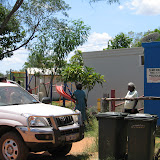 |
| Jarlmadang |
Labels: Aboriginal Health, Jarlmadangah

